Home|About|Races|Magazine|Events|Blogroll|Press|Contact|Browse Content
Leaderboard Ad

How to Avoid Pitfalls of Long Distance Running on Phil. Daily Inquirer

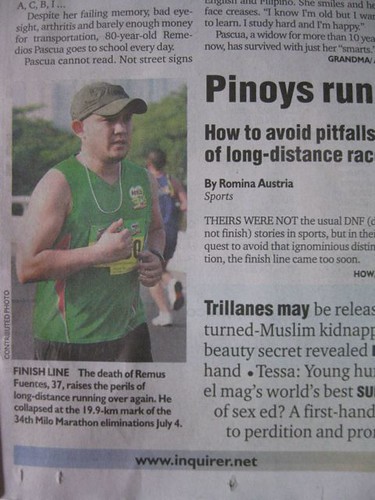
There’s a very well-written article on “How to Avoid Pitfalls of Long-Distance Running” by Romina Austria on Philippine Daily Inquirer today.  Click HERE to read the full article.

The article comes on the heels of the recent death of Remus Fuentes who passed away after the Milo Marathon.  It provides us with a glimpse of Remus, a runner and family man, like many of us and what exactly happened on the day he collapsed.  It also presents the side of Milo and its organizer, Rudy Biscocho.  More than that, it offers tips on proper training and how to avoid heatstroke.
Inquirer

As I said in an earlier post when I wrote about Remus (click HERE), I feel that the best response many of us can give at this point is to listen to our bodies and practice caution in our own runs. While it is the race organizer’s role to provide adequate support and medical assistance, it is also our responsibility as runners to train properly for the race.

If you are an experienced runner help spread the word about proper training and racing, especially to the beginners.  Let’s encourage people to run, but to do so at their own pace and to build their mileage gradually.  It took me months before I had the courage to run a 10k, and it took me longer to run the 21k.  Nowadays, it’s quite frightening to hear about newbies signing up for a 21k for their first event when they’ve never even run 5k (nor do they know how long 5k is!)

Yes, there’s a running boom.  Yes, we love it that more people are getting fit and healthy through running.  But, as I told a friend last year: We have to be careful that we don’t have a boom in injuries or worse fatalities.  This is a wake up call not just for organizers but for runners as well.

———————————

Just one comment about Rudy Biscocho’s claim in the article.   Mr. Biscocho said: “There was a hydration station (water or Gatorade) around every one kilometer of the 21K race path for a total of 13 water stations…”

I have deep respect for Mr. Biscocho as one of the leading race organizers in our country.  But, Sir, while there were stations at the last 3km of the 21k course, there was absolutely no water left to serve when I and several runners passed it.

———————————

These other articles may interest you:

«
»

14 Responses to “How to Avoid Pitfalls of Long Distance Running on Phil. Daily Inquirer”

  1. Hi Jaymie! I dropped by Inquirer about two weeks ago and actually told Romina that I read about Remus Fuentes(who was then unidentified) and his untimely demise through your blog so thank you for reporting that unfortunate incident. Hopefully, both runners and race organizers learn from it.

    Zo said on Jul 18 10 at 10:39 AM Reply
  2. hi bullrunner, where is your hgk marathon 2010 review? looked for it in your archives but can’t seem to find it..
    just wanted to know if the pollution there was really bad? thanks :)

    vv said on Jul 18 10 at 5:43 PM Reply
  3. this is rather a quick comment on this, but i need to put this this down before i lose my train of thought.

    this is really a bit of sad news for the sport that we all love. it’s really very easy to point fingers at everybody else. the race organizer for not providing ample water supply. the medics who took a long time in responding…its all very easy. me personally feel that its everybodys and nobodys fault. nobody wanted this to happen. as in all strenuous sports, running does have its calculated risks. and although there is no guarantee of a “safe” and “happy” run ALL THE TIME, there are ways of keeping misfortunes at a minimal. being a diver as well, and that diving, also is a high risk activity, remember one thing that my dive instructor tells us before every dive we do: that we have enough knowledge to keep ourselves safe. and that everybody is responsible for our own safety. for runners that holds true also.

    1. know your limits
    2. train train train. (so you will know WHAT your limit is)
    3. prepare/equip. gels. hydration. etc. ( dont leave it up to the organizer)
    4 be conscious during races. be aware of the race conditions. traffic. heat. air quality. etc.
    5. and although for a lot of us, running is everything, no race is more important than your life.

    dan said on Jul 18 10 at 11:19 PM Reply
  4. Athletes who finish marathon in the fastest times are also those who lose the most weight,they said the elite runners that finish the marathon in 2:06 have lose up to eight pounds ( or 5 percent of their body weight) during run.But they only drink a little “why”. Water and gatorade station is important but to much of it is also dangerous because of hyponatremia. This condition involves dilution of the blood to the degree that sodium levels fall.From RUNNER’S WORLD The RUNNER’S BODY .This is a good book about everything about our body.

    alaskarunner said on Jul 19 10 at 4:50 AM Reply
  5. “Nowadays, it’s quite frightening to hear about newbies signing up for a 21k for their first event when they’ve never even run 5k (nor do they know how long 5k is!)”

    If the trend goes with this, a disaster boom is looming.

    run unltd. said on Jul 19 10 at 10:31 AM Reply
  6. Alaskarunner, I agree with you regarding the hyponatrenia, and I did read that in your book. However, I do agree with Jaymie and Remus’ father that the water stations in the last 5 or 3Kms were mostly empty. In the latter and dangerous times of the 21K/42K race, the rate was no longer 1waterStation/2km, because most of the bulky 5K/10K runners have consumed them already. That happened to me last year and also this year. Although I highly respect Milo and RudyB, I agree that they failed in providing hydration in the latter stages of the 21K/42K race.

    i2runner said on Jul 19 10 at 3:45 PM Reply
  7. it’s not about the distance nor the PR time… it’s about the strong finish and the runner’s high feeling…

    CTA said on Jul 19 10 at 5:16 PM Reply
  8. i think that there was also insufficient hydration for 42K runners. i agree that it’s the responsibility of both the organizer and the runner to avoid these things from happening. i am guilty of not listening to my body. lesson learned and sadly, i had to learn it the hard way. thanks for the post jaymie.

    Reylynne said on Jul 19 10 at 8:34 PM Reply
  9. TBR,

    Mukhang pinatamaan ka ni bald runner sa blog niya na di mo daw minention si remus sa mga blog mo. buti pa daw yung namatay sa kuala lumpur. with your present blog, the issue is now settled adversely against the bald runner.hehe. peace.

    alaskador101 said on Jul 20 10 at 12:09 PM Reply
    • Alaskador, thanks. I read BR’s post. I cannot confirm if he was referring to me. But, I hope he wasn’t because I actually posted about Remus on July 7—days before he wrote the post you mentioned—on this link:

      http://thebullrunner.com/2010/07/07/tips-on-running-races-safely-from-the-experts/

      As I mentioned, the best way for me to respond to this is to help find ways to avoid it in the future. To provide unbiased and honest reviews of races to help organizers. And, to guide runners, especially beginners, on proper ways to prepare for a race.

      I’m not on a hunt for the person or organization to blame. I’m also not here to create issues out of such an unfortunate and tragic incident. Tulong tulong lang dapat for the entire running community.

      thebullrunner said on Jul 20 10 at 5:56 PM Reply
  10. Sir jovie aka the baldrunner was not bashing anyone in the blogging community but was just asking why no one has written about Remus` death and were all about personal concerns which is understandable because these are blogs written by the runners` themselves and i thinking writing about someone else will always fall second. Bottom line someone died, move forward,find ways of preventing it from happening again and not play the blaming game
    note as well, if there was still water in the aid stations at the last milo run – remus would have been able to cool his core temperature and would be able to drink water or gatorade, basically he got cooked from the inside out which is why his kidneys failed as well. Hyponatremia happend to the runner that did the test run at the BDM wherein the doctor found that his Na levels were below the normal tange – he only drank pocari sweat, for races that long and hot, you really need to experiment with your hydration and not rely on only the commercially bought drinks like gatorade.

    Dennis said on Jul 20 10 at 8:56 PM Reply
  11. Medics needs to be trained to provide medical intervention on site rather working as a medical transport. Time is crucial at this moment of medical crisis. Preparation of medical equipment for the usual problems ie cardiac, dehydration, heat stroke, low sugar and the usual problems with endurance competition.( blisters, sprain). I strongly believe it would have a better outcome. Stay safe. I train to run. I train to save lives….USAF medic.

    Running Medic said on Jul 21 10 at 1:30 AM Reply
  12. Fyi lang po, tumakbo po ako sa new zealand ng 5k wala po ni isang water station. Tumakbo rin po ako sa Malaysia ng 10k at isa lang po ang water station. Hindi po natin lubos batid ang tunay na nararamdaman ng bawat mananakbo at bawat mananakbo ay may kanya kanyang rason sa pagtakbo (for fun or for health or competitive etc). 42 years old na po ako at 2 years ng tumatakbo at kung kinakailangang mag lakad at huminto ito ay ginagawa ko upang makatakbo pang muli sa susunod na takbuhan. Ingat po sa lahat ng mananakbo.

    james said on Jul 24 10 at 2:39 PM Reply

Leave a Reply

Return to Top